
In a previous blog, David Harris described how the Quattrii blister becomes an active part of the aerosolisation system, rather than simply being a container for the dose. In our carrier-based technology, this allows the formulation to be deagglomerated and classified inside the blister: fine API particles are preferentially emitted, while most of the larger carrier fraction remains behind and is discarded with the used blister. However, this immediately raises another question – What happens if there is no carrier present?
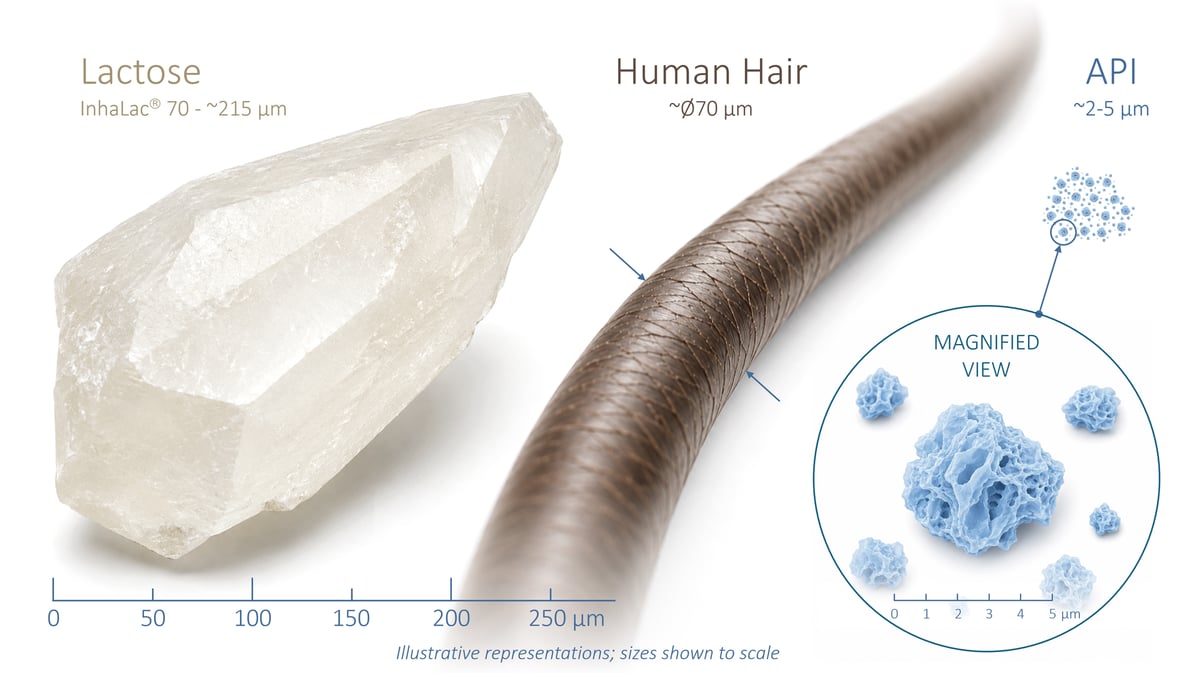
The above image gives some sense of the extraordinary difference in scale involved. A coarse lactose carrier particle, such as InhaLac® 70, may be a little over 200 µm across; a human hair is around 70 µm in diameter; and a respirable API particle may be only 2–5 µm. That difference becomes even more striking when mass is considered: a single large lactose carrier particle can be around a million times heavier than an individual respirable API particle. The precise relationship obviously depends on particle size, density and morphology, but the important point is that these are physically very different objects. Consequently, the underlying physics required to deagglomerate and aerosolise them efficiently is very different too.
A single large lactose carrier particle can be around a million times heavier than an individual respirable API particle.
In a carrier-based formulation, those tiny API particles are attached to the surfaces of much larger carrier particles, typically lactose. The job of the inhaler is therefore to fluidise the powder, detach the API from the carrier and then separate two populations of particles with enormously different size, mass and inertia. As described in a previous blog, carrier-based Quattrii uses the dose blister itself in which to perform much of this work: the fine API is preferentially emitted, while a large proportion of the much larger carrier fraction is retained and discarded with the blister. In this case, successful aerosolisation does not mean emptying the dose container; selective retention is an important part of the mechanism.
Carrier-free formulations present a very different challenge. There is no large carrier particle to separate from the API, and no carrier fraction that we want to leave behind. Instead, the formulation may consist almost entirely of very small engineered particles, often produced by processes such as spray drying. These powders can be highly cohesive, so particles that are individually well suited to reaching the lungs can agglomerate together and behave like much larger particles. Here, we need to extract as much of the formulation as possible, and use the available inhalation energy to break those agglomerates apart, producing a highly respirable aerosol.
Carrier-based and carrier-free formulations may both look like jars of powder on the laboratory bench, but the jobs we are asking the inhaler to perform are fundamentally different. With one, we want to detach, separate and classify; with the other, we want to empty and deagglomerate. In one case we deliberately retain a significant part of the formulation; in the other we want to deliver as much of it as possible. It therefore seems unreasonably optimistic to assume that exactly the same aerosolisation mechanism will be equally well suited to both.
Carrier-based and carrier-free formulations may both look like jars of powder on the laboratory bench, but the jobs we are asking the inhaler to perform are fundamentally different.
This is why we developed Quattrii as a common DPI platform, but with two complementary aerosolisation engines: one designed around carrier-based formulations, and the other around carrier-free powders. They share many of the things we want to keep common – individually sealed coldform blisters, passive operation using only the patient’s inhalation energy, similar product architecture and a common approach to developing a practical pharmaceutical product – but the way in which that inhalation energy interacts with the formulation is purposefully different.
There is also a useful development advantage to this approach. Formulation scientists do not necessarily know at the beginning of a programme exactly where they will end up. A molecule might initially be explored as a conventional carrier-based blend and subsequently as an engineered carrier-free powder, or several formulation approaches may be evaluated in parallel. The optimum formulation may ultimately depend on stability, manufacturability, dose, cost, molecule characteristics and aerosol performance. Ideally, the device should not unnecessarily constrain those decisions. Having carrier-based and carrier-free technologies within the same platform allows us to work with the needs of the formulation, instead of attempting to force every formulation through the same aerosolisation mechanism, and not necessarily achieve optimal performance.
This becomes particularly important as inhaled medicines become larger, more complex and more valuable. If the intended lung dose is tens of milligrams of an expensive biologic, vaccine, mRNA or other complex molecule, there is far less room for inefficient aerosolisation or unnecessary wastage. The formulation, primary package and aerosolisation system increasingly need to be considered together, and the limited energy available from the patient needs to be used as effectively as possible.
So, although our carrier-based and carrier-free Quattrii technologies belong to the same family, we have never tried to make their aerosolisation systems identical. The commonality is in the platform; the aerosolisation physics are allowed to be different.
If the powders present fundamentally different physical problems, it makes sense to give each of them an aerosolisation engine designed specifically for the job.
The commonality is in the platform; the aerosolisation physics are allowed to be different.
This blog post was originally published as part of a series of LinkedIn articles, written by David Harris.