---
title: What if the Blister Did More Than Hold the Dose?
description: Discover how Quattrii redefines dry powder inhalers by transforming the blister into an active aerosolisation system, enhancing drug delivery efficiency.
image: https://chi.uk/hubfs/182A4814pLI.jpg
---
[Skip to content](https://chi.uk/chi-blog/what-if-the-blister-did-more-than-hold-the-dose#main-content)
Close
- [ABOUT](https://chi.uk/about-us)
- [Why work with us](https://chi.uk/about-us#Work-with-us)
- [Our values](https://chi.uk/about-us#Values)
- [The team](https://chi.uk/about-us#Meet-the-team)
- [Where to find us](https://chi.uk/about-us#Contact)
- [PRODUCTS](https://chi.uk/products)
- [Quattrii](https://chi.uk/products#Quattrii)
- [Aeolus](https://chi.uk/products#Aeolus)
- [Occorix](https://chi.uk/products#Occorix)
- [THE SCIENCE](https://chi.uk/the-science)
- [VACANCIES](https://chi.uk/vacancies)
- [BLOG](https://chi.uk/chi-blog)
SEARCH
Contact us
[](https://chi.uk/home)
- [ABOUT](https://chi.uk/about-us)
- [Why work with us](https://chi.uk/about-us#Work-with-us)
- [Our values](https://chi.uk/about-us#Values)
- [The team](https://chi.uk/about-us#Meet-the-team)
- [Where to find us](https://chi.uk/about-us#Contact)
- [PRODUCTS](https://chi.uk/products)
- [Quattrii](https://chi.uk/products#Quattrii)
- [Aeolus](https://chi.uk/products#Aeolus)
- [Occorix](https://chi.uk/products#Occorix)
- [THE SCIENCE](https://chi.uk/the-science)
- [VACANCIES](https://chi.uk/vacancies)
- [BLOG](https://chi.uk/chi-blog)
Contact us
Quick results for "{search\_term}"
[David Harris](https://chi.uk/chi-blog/author/david-harris)Aug 17, 2026, 10:27:58 AM5 min read
# What if the Blister Did More Than Hold the Dose?
[Previous](https://chi.uk/chi-blog/the-dpi-was-design-for-yesterdays-medicines)
In most dry powder inhalers, the dose container has a pretty unglamorous job. It stores a pre-metered quantity of formulation, protects it from moisture in the atmosphere, and keeps it safely contained until the patient is ready to inhale. Once it has been opened or pierced, the powder leaves the dose container, and the useful aerosolisation work generally happens somewhere else downstream within the device. In other words, the blister is primarily packaging, while the inhaler contains the aerosolisation engine. When we started developing Quattrii, we wondered whether those two functions really needed to be separate?
> The blister is not simply the primary pack; it becomes an active part of the aerosolisation system.
An aluminium-laminate coldform blister is already an extremely useful component. It can provide excellent moisture protection for sensitive formulations, each dose remains individually sealed until the moment of use, and the blister itself provides a surprisingly useful volume within the device. So rather than simply opening it and trying to get all the powder out as thoroughly as possible, we asked whether we could actually use that volume to help fluidise, deagglomerate, and aerosolise the formulation. That simple question became one of the fundamental principles behind Quattrii: the blister is not simply the primary pack; it becomes an active part of the aerosolisation system.
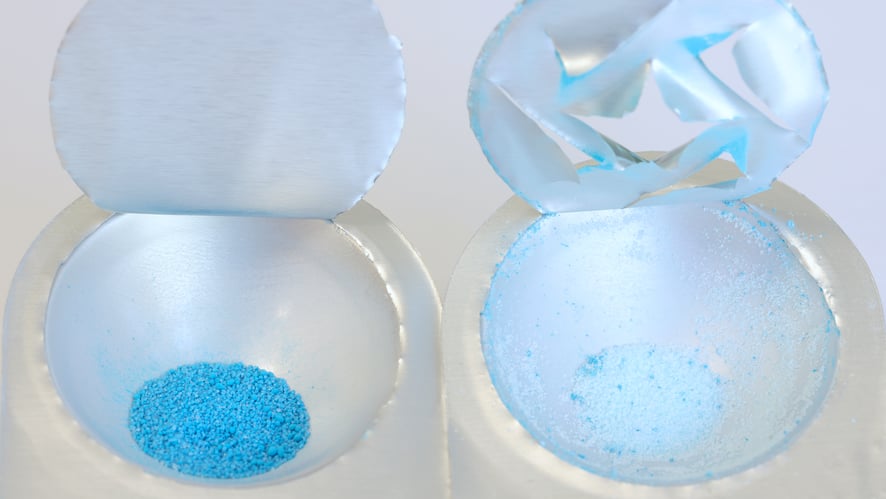
Figure 1: Before and after inhalation – lactose is retained; blue API-mimic is deagglomerated and emitted as a respirable aerosol.
The above photograph (Figure 1) visually demonstrates what this means. On the left is a carrier-based formulation before inhalation: a blend of lactose carrier and blue-dyed mannitol (API mimic), which gives the powder a striking blue appearance. On the right is the same type of formulation after being aerosolised by Quattrii. What remains in the blister is predominantly the larger, white lactose carrier fraction. The image looks almost too simple – but it illustrates an important point: Quattrii is not designed to empty the blister completely – it is designed to separate the formulation and preferentially deliver *only* the respirable fraction to the patient. Figure 2, below, shows a close-up comparison of the formulation before and after.
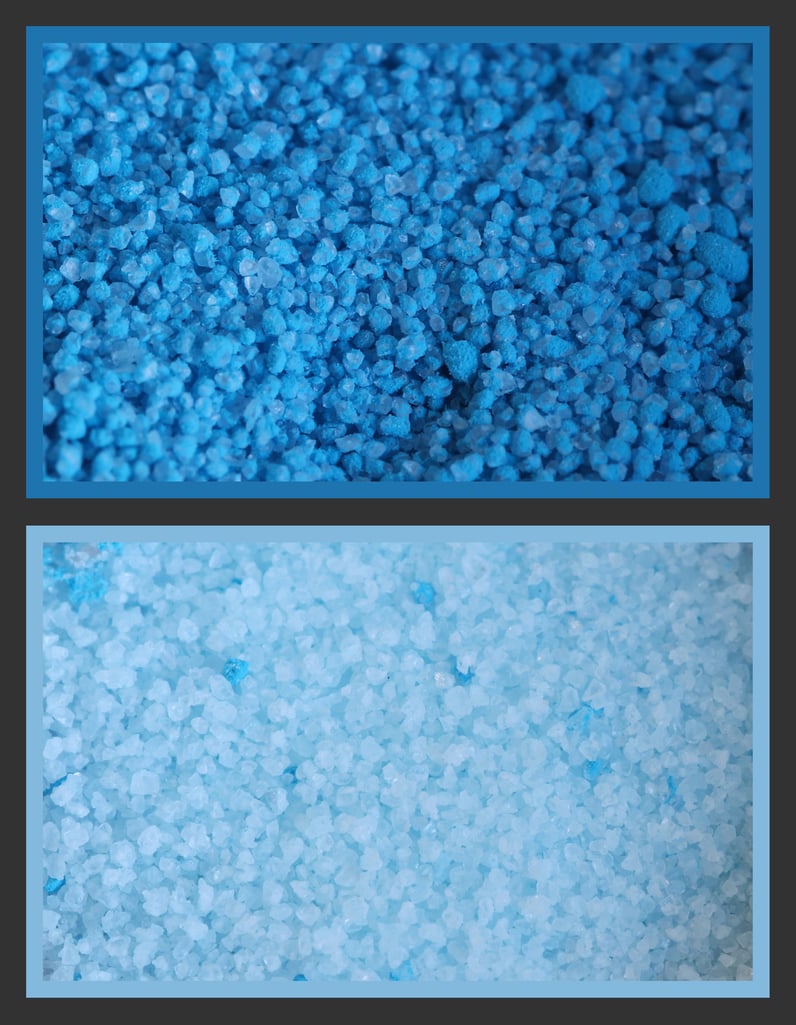
Figure 2: A close-up comparison of before and after blister contents: Top - blue API-mimic blended with lactose; Bottom - only large lactose particles remain within the Quattrii blister after inhalation.
In carrier-based Quattrii, the patient’s inhalation draws air into the blister through an array of carefully designed openings, creating a powerful cyclonic flow regime inside the dose cavity. The formulation circulates within this cyclone, and repeated particle-to-particle and particle-to-wall interactions help detach the fine drug particles from the much larger carrier particles. Once detached, the finer particles are much more able to follow the airflow out of the blister, while a large proportion of the heavier carrier particles remain behind. The blister therefore performs three jobs at once: it stores the dose, it acts as a deagglomeration and aerosolisation chamber, and it behaves as a particle classifier.
That last point is slightly counter-intuitive, because inhaler development often focuses heavily on emitted dose, and therefore on emptying the dose container as completely as possible. With a carrier-based formulation, however, complete emptying is not necessarily desirable, particularly when the requirement is to deliver high doses, such as biologics, vaccines, mRNAs, and other exciting new inhalable molecules. The patient needs the API in their lungs; they do not need large quantities of lactose – or other carrier material – depositing in their mouth and throat. If the API can be efficiently detached and emitted while much of the carrier is retained inside the blister, then leaving powder behind is not evidence of poor performance — it is part of the intended mechanism. The blue-and-white photograph illustrates that distinction rather neatly.
> Quattrii is not designed to empty the blister completely – it is designed to separate the formulation and preferentially deliver **only** the respirable fraction to the patient.
Of course, simply putting a few holes in a blister does not magically turn it into an effective cyclone. The size, position, direction and shape of the airflow openings matter, as does the way in which the foil behaves once it is pierced. An uncontrolled flap of lid foil can partially block an opening, alter the intended airflow or provide an easy bypass route around the formulation. Consequently, the piercing system in Quattrii is a highly integral part of the aerodynamic design rather than simply a means of accessing the blister. The aim is to create controlled, repeatable openings so that the flow field inside the blister is controlled and repeatable too.
There is something we particularly like about making the blister work harder. It has to be there anyway, because it stores and protects the medicine; by also using it as part of the aerosolisation engine, we gain a large and useful working volume without adding another complicated mechanism to the device. Additionally, each blister is effectively a disposable part of the system – you get a new one for each dose. This means any deposition within the blister (intentional or otherwise) does not unduly affect subsequent doses. This is key to enabling Quattrii to retain the vast majority of the carrier fraction, as it is disposed of with each blister. Importantly, the packaging, formulation and aerosolisation system can be considered together rather than as three largely independent problems. The blister becomes an integral part of the inhaler rather than something that simply happens to sit inside it.
> Leaving powder behind (in the blister) is not evidence of poor performance — it is part of the intended mechanism
For carrier-based formulations, the objective is to aerosolise and classify within the blister. Carrier-free powders present a very different challenge: there is no large carrier fraction to retain, so the whole dose needs to be emptied efficiently, and the cohesive powder then deagglomerated into respirable particles. That requires a different use of the available inhalation energy, which is why Quattrii has two complementary aerosolisation engines instead of attempting to design one mechanism do everything. This will be the subject of my next blog.
**This blog post was originally published as part of a series of [LinkedIn articles](https://www.linkedin.com/pulse/212-what-blister-did-more-than-hold-dose-david-harris-j5qke/), written by [David Harris.](https://www.linkedin.com/in/davidstuartharris/)**

#### [David Harris](https://chi.uk/chi-blog/author/david-harris)
David is passionate about improving the lives and wellbeing of patients. He has focused his 30-year career on the development of medical products, mainly in the field of respiratory drug delivery. As a physicist he enjoys the complex and challenging science that underpins inhalation and has more than 50 patent applications in the field, many of which have become part of commercially successful products. David is responsible for the technical development of new products.
[mailto:david.harris@chi.uk](mailto:david.harris@chi.uk)
## RELATED ARTICLES
Button Title
All rights reserved, Cambridge Healthcare Innovations Ltd 2024
- [Privacy policy](https://chi.uk/policies)
- Registered in England & Wales (GB11540827)
- [329 Cambridge Science Park, Cambridge CB4 0WG, UK](https://chi.uk/about-us#Contact)
```json
{
"@context" : "https://schema.org",
"@type" : "Organization",
"knowsLanguage" : "en",
"logo" : {
"@type" : "ImageObject",
"url" : "https://144863708.fs1.hubspotusercontent-eu1.net/hubfs/144863708/CHI.svg"
},
"name" : "",
"url" : "https://chi.uk/chi-blog/what-if-the-blister-did-more-than-hold-the-dose"
}
```
```json
{
"@context" : "https://schema.org",
"@type" : "BlogPosting",
"abstract" : "Discover how Quattrii redefines dry powder inhalers by transforming the blister into an active aerosolisation system, enhancing drug delivery efficiency.",
"author" : {
"@type" : "Person",
"name" : "David Harris"
},
"dateModified" : "August 17, 2026 9 AM",
"datePublished" : "August 17, 2026 9 AM",
"headline" : "What if the Blister Did More Than Hold the Dose?",
"image" : "https://144863708.fs1.hubspotusercontent-eu1.net/hubfs/144863708/182A4814pLI.jpg",
"inLanguage" : "en",
"keywords" : "[Science, quattrii, blister]",
"mainEntityOfPage" : {
"@type" : "WebPage"
},
"name" : "What if the Blister Did More Than Hold the Dose?",
"publisher" : {
"@type" : "Organization",
"logo" : {
"@type" : "ImageObject",
"url" : "https://144863708.fs1.hubspotusercontent-eu1.net/hubfs/144863708/CHI.svg"
},
"name" : ""
},
"text" : "In most dry powder inhalers, the dose container has a pretty unglamorous job. It stores a pre-metered quantity of formulation, protects it from moisture in the atmosphere, and keeps it safely contained until the patient is ready to inhale. Once it has been opened or pierced, the powder leaves the dose container, and the useful aerosolisation work generally happens somewhere else downstream within the device. In other words, the blister is primarily packaging, while the inhaler contains the aerosolisation engine. When we started developing Quattrii, we wondered whether those two functions really needed to be separate? The blister is not simply the primary pack; it becomes an active part of the aerosolisation system. An aluminium-laminate coldform blister is already an extremely useful component. It can provide excellent moisture protection for sensitive formulations, each dose remains individually sealed until the moment of use, and the blister itself provides a surprisingly useful volume within the device. So rather than simply opening it and trying to get all the powder out as thoroughly as possible, we asked whether we could actually use that volume to help fluidise, deagglomerate, and aerosolise the formulation. That simple question became one of the fundamental principles behind Quattrii: the blister is not simply the primary pack; it becomes an active part of the aerosolisation system. Figure 1: Before and after inhalation – lactose is retained; blue API-mimic is deagglomerated and emitted as a respirable aerosol. The above photograph (Figure 1) visually demonstrates what this means. On the left is a carrier-based formulation before inhalation: a blend of lactose carrier and blue-dyed mannitol (API mimic), which gives the powder a striking blue appearance. On the right is the same type of formulation after being aerosolised by Quattrii. What remains in the blister is predominantly the larger, white lactose carrier fraction. The image looks almost too simple – but it illustrates an important point: Quattrii is not designed to empty the blister completely – it is designed to separate the formulation and preferentially deliver only the respirable fraction to the patient. Figure 2, below, shows a close-up comparison of the formulation before and after. Figure 2: A close-up comparison of before and after blister contents: Top - blue API-mimic blended with lactose; Bottom - only large lactose particles remain within the Quattrii blister after inhalation. In carrier-based Quattrii, the patient’s inhalation draws air into the blister through an array of carefully designed openings, creating a powerful cyclonic flow regime inside the dose cavity. The formulation circulates within this cyclone, and repeated particle-to-particle and particle-to-wall interactions help detach the fine drug particles from the much larger carrier particles. Once detached, the finer particles are much more able to follow the airflow out of the blister, while a large proportion of the heavier carrier particles remain behind. The blister therefore performs three jobs at once: it stores the dose, it acts as a deagglomeration and aerosolisation chamber, and it behaves as a particle classifier. That last point is slightly counter-intuitive, because inhaler development often focuses heavily on emitted dose, and therefore on emptying the dose container as completely as possible. With a carrier-based formulation, however, complete emptying is not necessarily desirable, particularly when the requirement is to deliver high doses, such as biologics, vaccines, mRNAs, and other exciting new inhalable molecules. The patient needs the API in their lungs; they do not need large quantities of lactose – or other carrier material – depositing in their mouth and throat. If the API can be efficiently detached and emitted while much of the carrier is retained inside the blister, then leaving powder behind is not evidence of poor performance — it is part of the intended mechanism. The blue-and-white photograph illustrates that distinction rather neatly. Quattrii is not designed to empty the blister completely – it is designed to separate the formulation and preferentially deliver only the respirable fraction to the patient. Of course, simply putting a few holes in a blister does not magically turn it into an effective cyclone. The size, position, direction and shape of the airflow openings matter, as does the way in which the foil behaves once it is pierced. An uncontrolled flap of lid foil can partially block an opening, alter the intended airflow or provide an easy bypass route around the formulation. Consequently, the piercing system in Quattrii is a highly integral part of the aerodynamic design rather than simply a means of accessing the blister. The aim is to create controlled, repeatable openings so that the flow field inside the blister is controlled and repeatable too. There is something we particularly like about making the blister work harder. It has to be there anyway, because it stores and protects the medicine; by also using it as part of the aerosolisation engine, we gain a large and useful working volume without adding another complicated mechanism to the device. Additionally, each blister is effectively a disposable part of the system – you get a new one for each dose. This means any deposition within the blister (intentional or otherwise) does not unduly affect subsequent doses. This is key to enabling Quattrii to retain the vast majority of the carrier fraction, as it is disposed of with each blister. Importantly, the packaging, formulation and aerosolisation system can be considered together rather than as three largely independent problems. The blister becomes an integral part of the inhaler rather than something that simply happens to sit inside it. Leaving powder behind (in the blister) is not evidence of poor performance — it is part of the intended mechanism For carrier-based formulations, the objective is to aerosolise and classify within the blister. Carrier-free powders present a very different challenge: there is no large carrier fraction to retain, so the whole dose needs to be emptied efficiently, and the cohesive powder then deagglomerated into respirable particles. That requires a different use of the available inhalation energy, which is why Quattrii has two complementary aerosolisation engines instead of attempting to design one mechanism do everything. This will be the subject of my next blog. This blog post was originally published as part of a series of LinkedIn articles, written by David Harris.",
"url" : "https://chi.uk/chi-blog/what-if-the-blister-did-more-than-hold-the-dose",
"wordCount" : "1486"
}
```
```json
{
"@context" : "https://schema.org",
"@type" : "BlogPosting",
"author" : {
"@type" : "Person",
"name" : "David Harris",
"url" : "https://chi.uk/chi-blog/author/david-harris"
},
"dateModified" : "2026-08-17T09:27:58.176Z",
"datePublished" : "2026-08-17T09:27:58.000Z",
"headline" : "What if the Blister Did More Than Hold the Dose?",
"image" : [ "https://chi.uk/hubfs/182A4814pLI.jpg" ],
"mainEntityOfPage" : {
"@id" : "https://chi.uk/chi-blog/what-if-the-blister-did-more-than-hold-the-dose",
"@type" : "WebPage"
},
"publisher" : {
"@type" : "Organization",
"logo" : {
"@type" : "ImageObject",
"url" : "https://chi.uk/hubfs/CHI.svg"
},
"name" : "Cambridge Healthcare Innovations Ltd."
}
}
```