

Novel inhaled therapies, including biologics and large molecules are changing what we need from dry powder inhalers. Delicate molecules need protecting during shelf-life and aerosolisation, and respirable doses are much higher than traditional small molecule therapies. Consequently, the methods we use to measure performance also need scrutiny.
At Intertek’s Inhaled & Nasal Biologics DNA Forum, CHI’s Dr Heather Jameson explored how formulation, device design and testing must be considered together throughout product development.
Download a copy of the slides here
Quattrii stores powder directly in sealed foil blisters, protecting moisture-sensitive formulations until use. Its carrier-free platform accommodates a range of fill masses, offering flexibility across applications and as dose requirements change during development.
Using a spray-dried biologic placebo, we evaluated fills from 18 to 72 mg. Quattrii demonstrated consistently good performance across this range, with fine-particle fractions above 50% for all fill masses, at both 2 and 4 kPa (34 and 48 LPM) test points.
However, testing revealed another challenge. High powder loads caused particle bounce and re-entrainment in the Next Generation Impactor (NGI), distorting the measured particle-size distribution. We responded to this by developing a novel method...
Our novel "sample" method split the aerosol between two branches, reducing powder loading and airflow through the NGI while preserving the inhaler’s operating conditions. This reduced bounce and produced less skewed distributions.
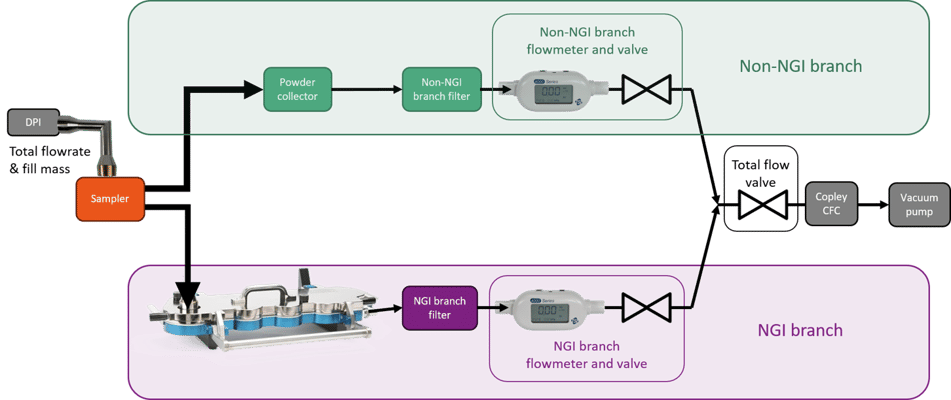
Schematic of CHI's "sample" method for reducing powder bounce and re-entrainment in the NGI by reducing overloading and NGI flowrate
We have a collaboration with King's College London to further develop the "sample" method. The broader message is clear: delivering inhaled biologics requires suitable devices and test methods that keep pace with changing formulation demands.
Quattrii carrier-free is available for evaluation now. Get in touch to test your formulation.