
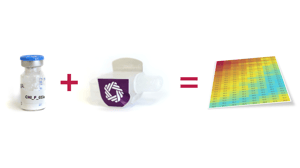
Imagine spending months, perhaps years, developing a spray-dried inhalation formulation. The particle size and morphology are where you want them, the composition is fixed, the manufacturing process is behaving itself and the stability programme can finally begin. Then you put that formulation into the DPI you intend to use – and discover that the aerosol performance isn’t quite good enough.
At that point, none of the obvious options are especially attractive. You can go back and modify the formulation, potentially disturbing properties that have already been painstakingly established. You can screen other inhalers and hope that one happens to suit the powder better. Or you can accept a compromise in aerosol performance. For a pharmaceutical development team trying to lock the drug product and move towards the clinic, this is exactly the sort of late interaction between formulation and device that nobody wants, but often where it ends up.
The difficulty is that there is no universally ideal deagglomeration engine for every dry powder. Powders differ in particle size distribution, morphology, density, cohesion, surface chemistry, dose mass and the strength and nature of their agglomerates. They can also have completely different therapeutic requirements. A device geometry that produces excellent deep-lung delivery from one formulation may be far from ideal for another.
A stable formulation should not have to be reoptimised simply because it was unfortunate enough not to match the fixed fluid dynamics of an existing DPI.
Making a DPI tuneable sounds like an obvious solution, but doing it usefully is difficult. Changing one airflow dimension alters pressure drop, velocity, mass flow, turbulence and the quantity and type of energy delivered to the powder. Those effects interact throughout the aerosolisation engine. The overall device resistance still needs to suit the intended patient population, and whatever geometry we select eventually has to be manufacturable as a commercial device. Exploring every possible combination experimentally with an NGI would consume an enormous amount of time and formulation, so isn’t very practical.
Carrier-free Quattrii was designed around this problem. In the current Quattrii Clinical architecture, the critical dimensions used to tune aerosol performance are contained within one simple moulded component. We can change how the formulation experiences the aerosolisation engine while keeping the rest of the platform, the primary package and the patient interaction unchanged.
The carrier-free engine has three tuneable stages. I need to be slightly guarded about the detailed geometry because several of the patents covering these parts of the technology are still unpublished, but the fluid-dynamic principles and our optimisation methodology were presented publicly at DDL in December 2024. Each stage can be adjusted independently, changing parameters including kinetic-energy flow and Reynolds number, while the combined system geometry determines the total device resistance.
In the current Quattrii Clinical architecture, the critical dimensions used to tune aerosol performance are contained within one simple moulded component.
This gives us a three-dimensional design space. Once we choose the target resistance for the intended patient population, only certain combinations of those three dimensions satisfy it. Geometrically, those combinations form a surface through the larger design space, which we can map into a two-dimensional region and explore experimentally. We are therefore free to redistribute the available aerosolisation energy within the engine without casually changing the resistance experienced by the patient (Figure 2).
The DDL2024 study demonstrated the principle using Owlstone Medical's carrier-free spray-dried formulation. We characterised the engine using seven fluid-dynamic parameters — Reynolds number and kinetic-energy flow for each of the three stages, plus total device flow rate — and compared them with real APSD measurements from eight geometries. When all seven parameters were initially given equal importance (unity-weighted), their combined score described measured MMAD poorly, with an R² of approximately 0.42 (Figure 1). Once the weightings were adjusted to reflect the measured aerosol behaviour of that formulation, the fit increased to 0.94.
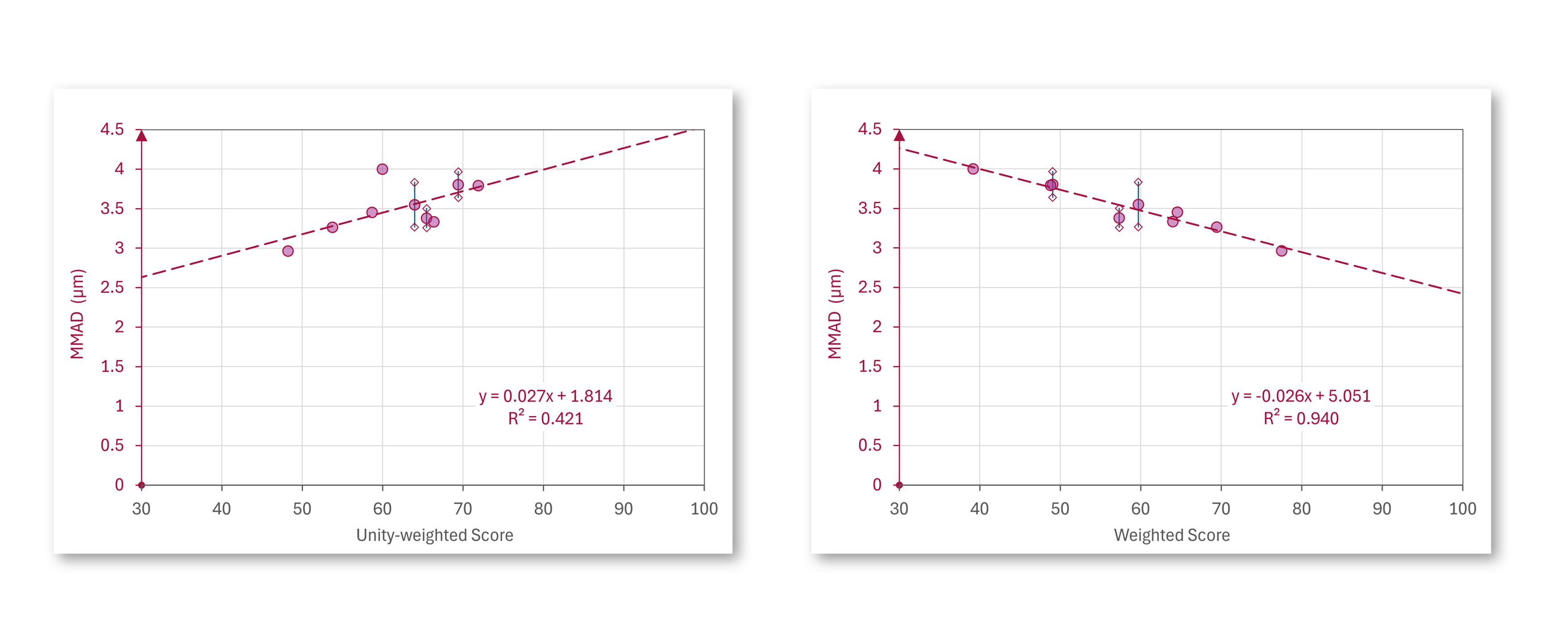
Figure 1: Tuning the fluid-dynamic weightings improved the fit with measured MMAD from R²≈0.42 to 0.94 for the eight geometries tested.
What I particularly like about that result is what it tells us about the powder. The formulation effectively shows us which aspects of the fluid dynamics matter most to its aerosolisation. For the powder used in the DDL study, for example, the fitted model suggested that some parameters had considerably more influence on MMAD than others. Another formulation can produce a different set of weightings and a different optimum region of the same Quattrii design space.
The formulation effectively shows us which aspects of the fluid dynamics matter most to its aerosolisation.
MMAD was deliberately chosen as a convenient output for the published study, but there is no reason that the optimisation target has to be MMAD. We can optimise against fine particle dose, fine particle fraction, emitted dose, mouth and throat deposition or combinations of APSD outputs. The required aerosol depends on the medicine.
Consider an inhaled cytotoxic treatment for lung cancer. Driving every particle as deeply into the alveolar region as possible may not be the primary objective. We might instead want very low mouth and throat deposition combined with broad deposition throughout the conducting airways and peripheral lung. The APSD target for that product could be quite different from one designed primarily for very deep lung delivery, and Quattrii can be tuned against those different requirements.
Since the DDL2024 work we have developed this into a practical formulation-tuning workflow. For a new powder, we first agree the target device resistance and the aerosol performance we are trying to achieve. We then manufacture nine high-resolution SLA engine geometries distributed across the relevant design space and test each by NGI in triplicate. Twenty-seven APSD measurements can typically be completed in about a week.
Those measurements are fed back into the numerical model, which uses a solver to adjust the importance of the underlying fluid-dynamic parameters, and identify the region most likely to give the desired aerosol. We then concentrate a second experimental campaign that is more tightly focused around that region, typically testing another nine geometries with more replicates. Within roughly another two weeks we have a high-resolution experimental and numerical picture around the predicted optimum.
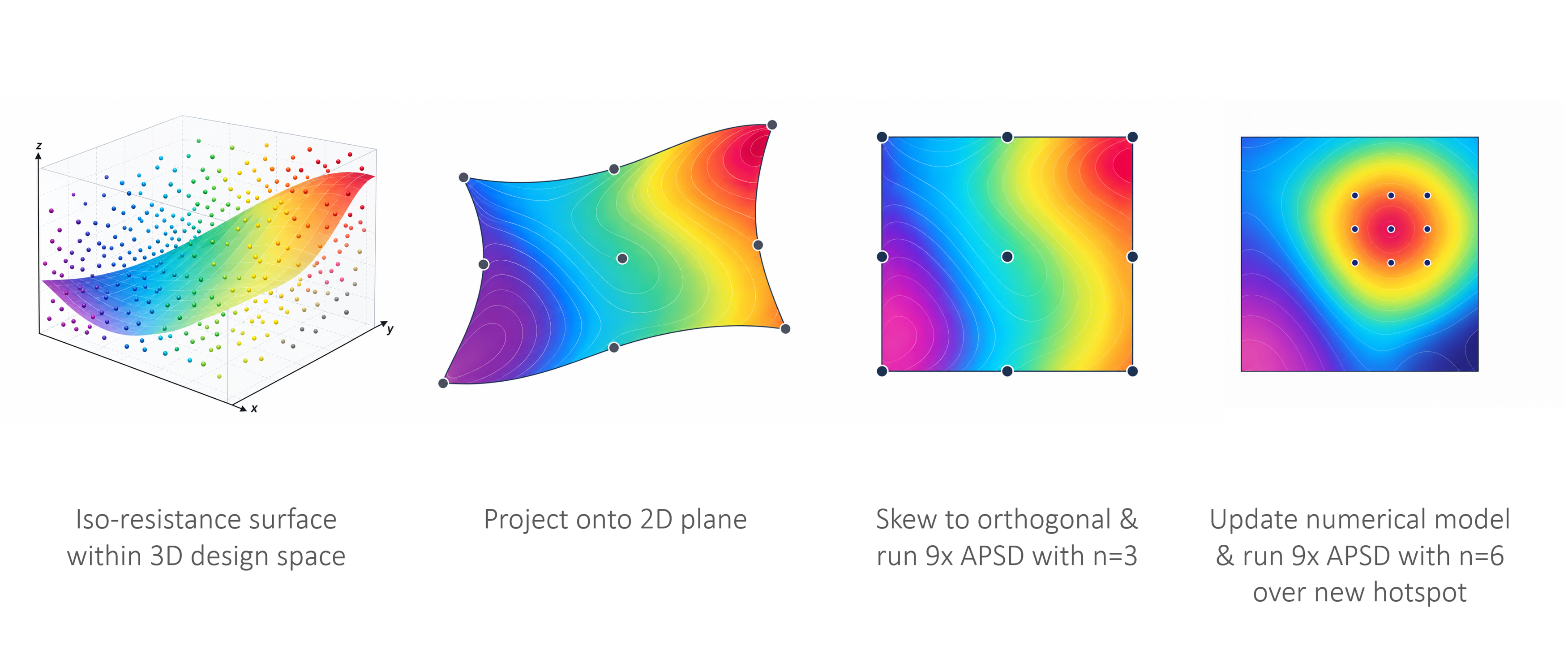
Figure 2: Schematic illustration: Mapping Quattrii’s carrier-free design space, from a 3D iso-resistance surface to a focused formulation-specific optimisation.
So, in around three weeks, we can take a new carrier-free formulation, map how it behaves within Quattrii, identify the aerosolisation conditions that best meet its pharmaceutical requirements and define the geometry of a formulation-specific engine component. Development is done with SLA parts; once selected, the final geometry can be frozen into the single open-shut moulded component used within the Quattrii Clinical platform. The device around it does not need to become a different product.
In around three weeks, we can take a new carrier-free formulation and define a formulation-specific Quattrii engine geometry around it.
For a formulation scientist, this changes the development conversation quite considerably. A stable formulation should not have to be reoptimised simply because it was unfortunate enough not to match the fixed fluid dynamics of an existing DPI. Primary-pack work and stability programmes can continue while we optimise the inhaler around the powder. If the formulation is still early and flexible, the reverse approach remains perfectly possible; our standard moulded Quattrii engine provides a strong general-purpose starting point around which the formulation can be developed.
The ability to explore both routes is important because formulation development is rarely neat enough for one prescribed sequence to suit every programme – sometimes the powder is fixed first – but more usually the inhaler is. Quattrii has been engineered so that either can happen without forcing the entire product back to the beginning.
A new formulation does not have to fit the aerosolisation engine we happened to design years earlier. We can tune the engine to fit the formulation and specific patient requirements.
This blog post was originally published as part of a series of LinkedIn articles, written by David Harris.