
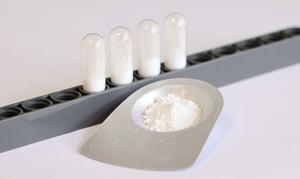
The last couple of blog posts looked at some of the challenges associated with delivering larger quantities of powder to the lungs. Carrier-based and carrier-free formulations present very different aerosolisation problems, but they have something important in common: as the required lung dose increases, the limitations of conventional DPI architectures become much more apparent.
For many established respiratory medicines this has never really been an issue. The drug is highly potent, the required dose may be measured in micrograms, and only a relatively small quantity of formulation needs to be packaged and aerosolised for each treatment. Newer inhaled therapies can look quite different – biologics, vaccines, peptides, mRNAs and other emerging molecules may require milligram or even tens-of-milligrams lung doses, sometimes using low-density engineered powders that occupy a surprisingly large volume. If an inhaler can only accommodate or efficiently aerosolise a modest quantity of powder at a time, the obvious solution is to divide the treatment into several separate doses.
That works, of course. But it is worth asking whether it should really be the starting point.
Each additional inhalation is another patient operation. Depending on the product, the patient may need to open a device, insert or expose another dose, pierce it, inhale correctly, remove it from the inhaler, confirm that the dose has been taken, and then repeat the process several times. Even with a multidose device, the patient still has to perform several inhalation manoeuvres to receive one therapeutic treatment. More inhalations also mean more opportunities for variation between manoeuvres, and potentially more formulation left behind in the device or deposited somewhere other than the lungs. A treatment that requires several separate inhalations may be entirely acceptable, but if the same lung dose could be delivered efficiently in one, that would seem preferable.
A high drug dose does not necessarily need to mean a high number of inhalations.
There are really two engineering problems hiding underneath this. The first is simply capacity: can the primary package physically hold enough formulation? As discussed in the last blog, this becomes particularly important for low-bulk-density spray-dried powders, where perhaps 70 mg of formulation can occupy a surprisingly large volume. The second problem is considerably harder: can the inhaler actually aerosolise that amount of powder efficiently during a single inhalation? A large blister that comfortably accommodates the formulation is not especially useful if half the dose remains behind, or if much of the emitted powder reaches the patient as poorly deagglomerated material.
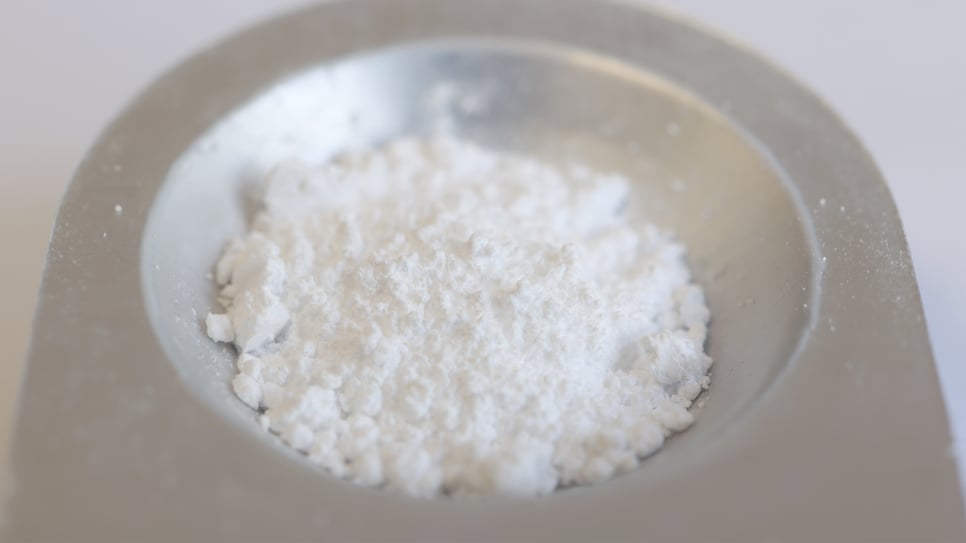
70 mg of spray-dried formulation contained within a single Quattrii blister. High payload is useful — but only if the inhaler can also aerosolise it efficiently.
This is why we think the phrase “high-payload DPI” can be slightly misleading. Payload capacity is certainly important, but the number on the side of the dose container only tells us how much powder we can put into the inhaler. What ultimately matters is how much useful, respirable material we can get out of it. A device capable of containing 70 mg but only able to efficiently aerosolise a fraction of that dose has solved the easier half of the problem.
A device capable of containing 70 mg but only able to efficiently aerosolise a fraction of that dose has solved the easier half of the problem.
For Quattrii, we have therefore treated dose capacity and aerosolisation efficiency as parts of the same engineering challenge. The blister needs to be large enough to hold and protect a clinically useful quantity of formulation, while the aerosolisation system needs to use the patient’s available inhalation energy effectively enough to fluidise, deagglomerate and emit that dose as a high-quality aerosol. As described in our previous blog, that does not necessarily mean trying to perform all of those functions within the blister itself. Different parts of the system can be optimised for different jobs.
The same thinking applies to carrier-based formulations. If increasing the API dose also means increasing the quantity of carrier, simply increasing the overall formulation mass can rapidly create another problem: the patient may receive a very large quantity of non-respirable material in their mouth and throat. This is one reason why selective emission and carrier retention are important within carrier-based Quattrii. Increasing payload is only useful if we can increase the amount of useful material delivered without simply scaling all of the unwanted material with it.
There is also a subtle difference between delivering a large powder mass and delivering a large lung dose. They are not interchangeable. If two inhalers both contain 70 mg of formulation, but one produces a substantially greater respirable fraction, then the patient may receive a larger useful dose from the same nominal payload. Conversely, improving aerosolisation efficiency may enable a required lung dose to be achieved with less formulation in the first place. This becomes particularly important when the formulation is expensive, difficult to manufacture, or contains a valuable biological molecule.
The objective should not be to put the largest possible quantity of powder into an inhaler. It should be to deliver the required lung dose as efficiently and conveniently as possible.
That changes the way we think about high-dose inhalation. Instead of asking how many capsules, blisters or inhalations will be needed to accommodate a particular quantity of formulation, perhaps the better question is: what would the device need to do to deliver the required lung dose in a single treatment event?
There will obviously be practical limits, and there will be medicines for which several inhalations remain entirely appropriate. But multiple inhalations should be a clinical or product choice, not an unavoidable consequence of an inhaler architecture originally designed around much smaller doses.
For the emerging generation of inhaled medicines, we think that distinction matters a lot.
Multiple inhalations should be a clinical or product choice, not an unavoidable consequence of an inhaler architecture originally designed around much smaller doses.
This blog post was originally published as part of a series of LinkedIn articles, written by David Harris.