
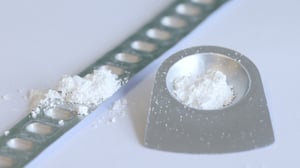
The previous few blog posts have concentrated mainly on carrier-based dry powder formulations: why tiny API particles are blended with much larger carrier particles, how Quattrii uses the dose blister to help separate them again during inhalation, and why retaining most of that carrier within the blister can actually be beneficial to the patient. Carrier-free formulations remove the carrier from the equation altogether, which sounds as though it ought to make things considerably easier. Unfortunately, it doesn’t.
The fundamental challenge is that particles intended to reach deep into the lungs need to be aerodynamically very small. For many inhaled medicines we are dealing with particles only a few microns in aerodynamic diameter, and at this scale their behaviour is increasingly dominated by surface interactions rather than their own weight or inertia. Van der Waals forces, electrostatic effects, moisture and the physical characteristics of the particle surfaces can all encourage the particles to stick to one another, to the dose container and to the inhaler itself. The very properties that make a particle suitable for reaching the lungs can also make it extremely difficult to get there.
This is one reason why spray drying has become so interesting for newer inhaled medicines. It gives formulation scientists considerable control over particle composition, morphology, density and other properties, and can enable complex molecules such as biologics, peptides, vaccines, mRNAs and other emerging therapies to be formulated directly as respirable particles, without needing to be blended with a conventional coarse carrier fraction. The particles can also be engineered with a very low material density, reducing their aerodynamic diameter and improving their potential for effective lung delivery. However, producing a beautifully engineered respirable powder is only half of the problem; the inhaler still has to turn perhaps tens of milligrams of that cohesive powder into an useful aerosol using nothing more than the energy supplied by the patient.
Carrier-free powders can be highly cohesive, and individual respirable particles readily form agglomerates that behave aerodynamically like much larger particles. During inhalation, the powder therefore needs to be fluidised, extracted from the dose container and, critically, those agglomerates need to be broken apart sufficiently for the individual particles to become respirable again. The scale of that task is easy to underestimate. As an order-of-magnitude illustration, a 70 mg dose consisting of particles with an aerodynamic diameter of approximately 1.8 µm can represent something approaching 30 billion individual particles. The inhaler is therefore being asked to take a cohesive bulk powder containing billions upon billions of microscopic particles, get them moving, separate their agglomerates, and convert as much of that dose as possible into a high-quality respirable aerosol.
A 70 mg dose consisting of particles with an aerodynamic diameter of approximately 1.8 µm can represent something approaching 30 billion individual particles.
This is where high-payload carrier-free delivery starts to become particularly interesting. A 70 mg dose of a low-bulk-density spray-dried formulation occupies a surprisingly large volume, so the blister needed simply to store and protect the formulation also has to be correspondingly large. Coldform aluminium is an excellent primary packaging material, but it brings practical geometric constraints, and a large coldform blister has a substantial internal surface area and volume. Those characteristics are useful for storing a large dose, but they are not necessarily what we would choose if our primary objective were to create a compact, high-energy deagglomeration chamber.
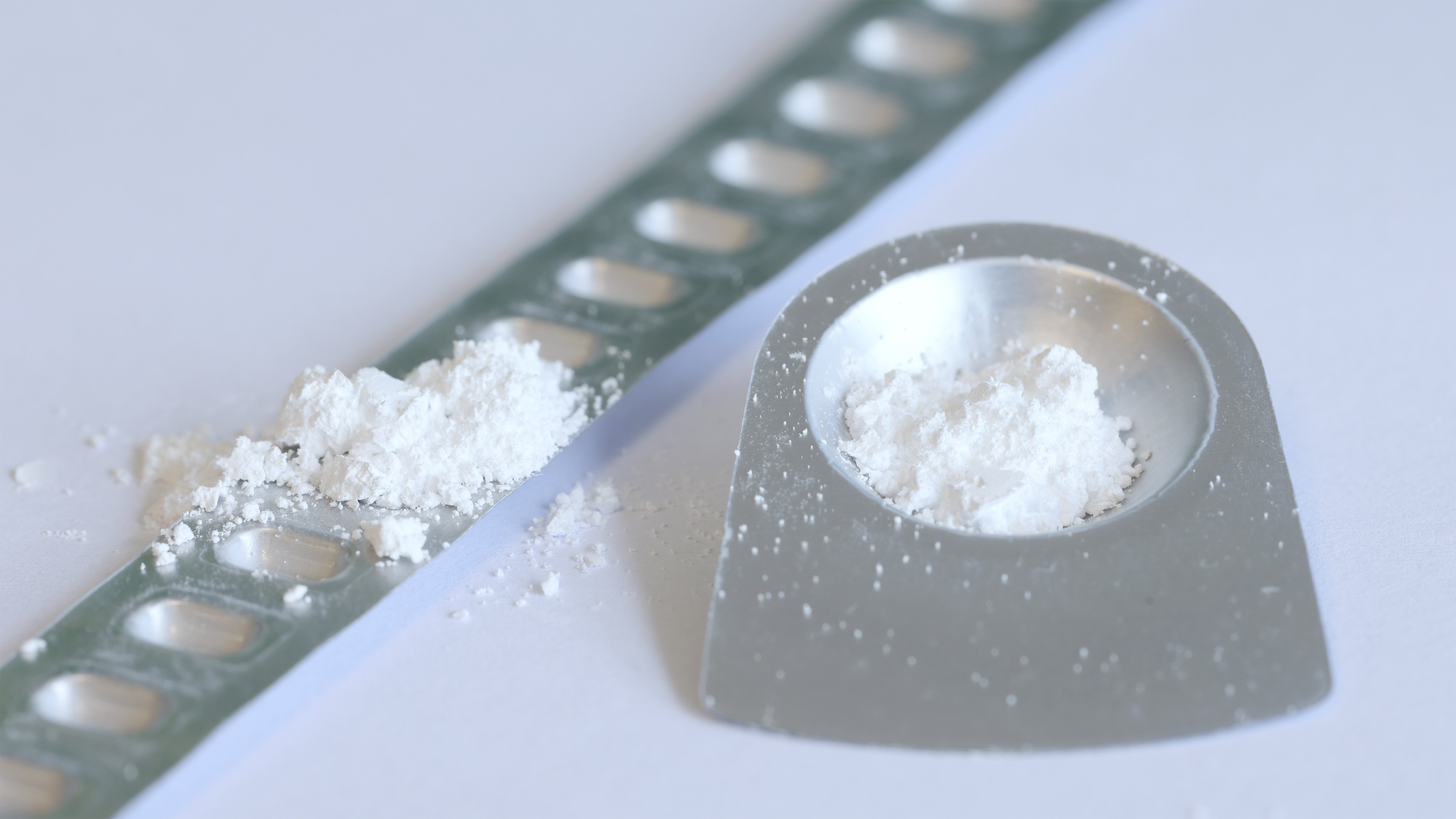
70 mg changes the packaging problem. The same spray-dried powder that overwhelms a conventional DPI blister fits comfortably within an 800 µL Quattrii blister.
The difficulty is not simply one of fitting the powder into the device. To break cohesive agglomerates apart efficiently, we need useful energy density in the airflow – and the ability to generate high acceleration and shear where they will do useful work on the powder. Trying to achieve that within a relatively large blister means spreading the available inhalation energy through a large volume and across a substantial surface area, within a geometry that has primarily been dictated by primary packaging manufacturing requirements. A blister can be an excellent place to store a large dose without necessarily being the best place to fully deagglomerate it.
A blister can be an excellent place to store a large dose without necessarily being the best place to fully deagglomerate it.
Fortunately, extracting a bulk spray-dried powder from the blister does not itself require very much energy. Fluidising the powder and getting it moving can consume only a small proportion of the energy available from the patient, even when inspiratory capability is significantly compromised. That leaves a substantial part of the available energy budget to do the more difficult job: breaking down cohesive agglomerates and generating a high-quality respirable aerosol.
This observation was important in the development of carrier-free Quattrii. Rather than trying to force all of the aerosolisation work to happen within a large coldform blister, we separated the functions. The blister can concentrate on the jobs it is particularly good at – storing a relatively large dose, protecting it from moisture, and enabling the powder to be fluidised and extracted – while the more demanding deagglomeration work can be performed downstream, where the available inhalation energy can be concentrated and focused within a smaller, purpose-designed space envelope.
That distinction matters. High acceleration, high shear and other useful aerosolisation conditions can be optimised much more effectively in geometry designed specifically for that purpose than within a simple, coldform tray – whose dimensions are constrained by dose volume, forming limits, sealing requirements and primary packaging manufacturability. By concentrating the useful energy into a smaller region, we can transfer it into the powder more efficiently and generate a more efficacious aerosol, rather than simply moving a large volume of air relatively slowly through a large dose cavity.
High payload and efficient aerosolisation are therefore two separate engineering problems. A useful high-dose DPI needs to solve both. Making the blister large enough to contain 70 mg is comparatively straightforward; getting that 70 mg out, breaking apart the agglomerates, and presenting as much of it as possible to the patient as a respirable aerosol, is where the real engineering challenge begins.
There is considerably more going on inside the carrier-free Quattrii engine than we can share at the moment, because several of the newer patent applications covering the technology have not yet published. What we can say is that the platform was developed around this separation of functions: use the blister for the things that a blister can do particularly well and use purpose-designed aerosolisation geometry for the things that require much greater local energy density.
This also returns us to an important theme running through this series. As inhaled medicines become larger, more complex and more valuable, the formulation, primary package and inhaler increasingly need to be developed as parts of the same system. A formulation scientist may create extraordinary spray-dried particles with exactly the aerodynamic characteristics required for effective lung delivery, but if the inhaler cannot reliably fluidise, deagglomerate and aerosolise a clinically useful quantity of that powder, much of that clever formulation work is wasted.
Making a respirable particle is one challenge. Reliably turning 70 mg of those particles into a respirable aerosol is a very different one.
This blog post was originally published as part of a series of LinkedIn articles, written by David Harris.